
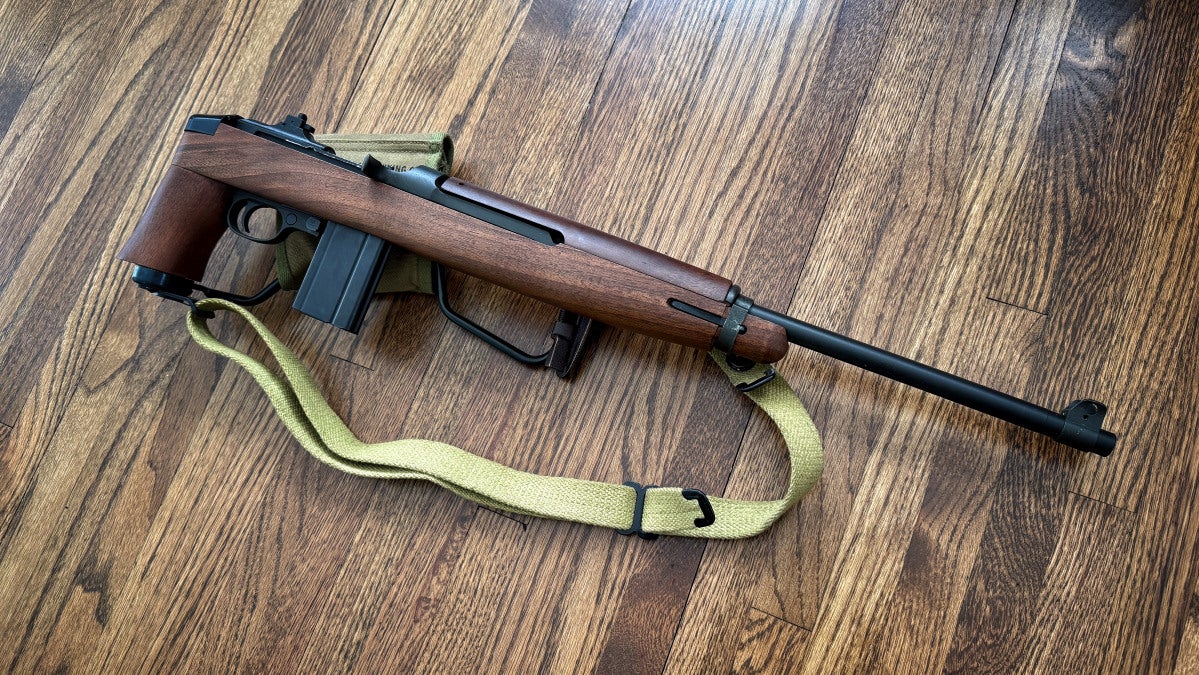

Welcome back, folks! Last time we covered the development story of the M1 Carbine, from that frantic 13-day prototype sprint at Winchester to the reality behind the David Marshall Williams legend. Today, we’re diving into the manufacturers who cranked out over six million of these things and the variations that made the M1 Carbine family more than just a one-trick pony. Let’s get into it!
Curious Relics Coverage on AllOutdoor
Welcome to our recurring series of “Curious Relics.” Here, we want to share all of our experiences, knowledge, misadventures, and passion for older firearms that one might categorize as a Curio & Relic – any firearm that is at least 50 years old according to the ATF. Hopefully along the way you can garner a greater appreciation for older firearms like we do, and simultaneously you can teach us things as well through sharing your own expertise and thoughts in the Comments. Understanding the firearms of old, their importance, and their development which lead to many of the arms we now cherish today is incredibly fascinating and we hope you enjoy what we have to share, too!
The Manufacturers
Hard to dive into “Variations” without mentioning the many different entities that contributed to making the M1 a wartime reality. When Winchester won the contract in October 1941, nobody expected Pearl Harbor less than two months later. Suddenly, one company couldn’t possibly meet wartime demand. The government authorized contract production on a royalty-free basis, paying Winchester $886,000 for development costs and allowing anyone with manufacturing capability to tool up and start building carbines. What followed was one of the most impressive industrial mobilization efforts in American history.
The primary contractors who built complete M1 Carbines read like a “who’s who” of American manufacturing, and not all of them had any business building guns.
- Inland Manufacturing Division of General Motors was the undisputed champion, producing approximately 2,632,097 carbines, roughly 43% of total wartime production.
- Winchester, despite designing the thing, came in second with around 828,059 units.
- Underwood Elliott Fisher (the typewriter people) at 545,616
- Saginaw Steering Gear Division of GM at 517,212
- National Postal Meter at 413,017
- Quality Hardware (link here) at 359,666
- International Business Machines (yes, that IBM) at 346,500
- Standard Products at 247,160
- Rock-Ola Manufacturing at 228,500.
Rock-Ola is probably the crowd favorite among collectors. Here was a company famous for making jukeboxes, and they ended up producing nearly a quarter million military carbines. From what I have read, GIs who grew up feeding nickels into Rock-Ola jukeboxes at the local diner got a kick out of seeing that same name stamped on their carbine receiver. IBM is another head-scratcher for most people. The company that would eventually dominate mainframe computers was cranking out carbine parts at its typewriter plant in Lexington, Kentucky, during the war. That same facility later became Lexmark.
One thing worth knowing if you’re new to M1 Carbines: the name on the receiver doesn’t mean that the company built the whole gun. These were true mixed-parts firearms from day one. Underwood came closest to full in-house production, turning out around two-thirds of the carbine’s components at their Connecticut facilities. Quality Hardware sat at the opposite end of the spectrum. They stamped receivers, and that was about it. Everything else came from the government supply chain or other contractors. The bolt in your Winchester might have been made by a completely different company than the operating rod.

“Rockola M1 Carbine Carbine 30 Carbine.” Rock Island Auction, www.rockislandauction.com/detail/73/1784/rockola-m1-carbine-carbine-30-carbine. Accessed 6 Jan. 2026.
Parts from all makers were required to be completely interchangeable. A bolt from IBM had to fit in a Winchester receiver with a Rock-Ola operating rod. The whole program was managed by a government-run “Carbine Industry Integration Committee” that kept parts flowing between contractors to prevent bottlenecks.
Subcontractors numbered in the hundreds. National Postal Meter, for example, used barrels mostly made by Underwood and stock assemblies manufactured by Trimble Nurseryland Furniture Company, a baby furniture maker located about six miles away in Rochester. New Haven Clock Company, National Lock Company, even Auto-Ordnance (the Thompson submachine gun people) produced various carbine parts. The production program was so successful that by mid-1944, contracts for everyone except Inland and Winchester were cancelled. Those two companies finished out their production runs in August 1945.
Variations: The M1 Carbine Family
The standard M1 Carbine was just the beginning. The military developed several variants to meet different tactical needs, though not all of them made it past the prototype stage. For the sake of my sanity and the encouragement of your own book buying and research, I will stick to the main ones.
M1A1 Carbine – The Paratrooper
Not long after the M1 Carbine was adopted, the need for a more compact version became evident. American airborne troops couldn’t exactly jump out of planes with a full-length stock banging around. In early 1942, U.S. Army Ordnance requested designs for a folding or collapsible stock variant. Inland Division submitted their drawings in March 1942, and after some revision, the design was standardized as the M1A1 on May 12, 1942.

The M1A1 was beautifully simple. It was just a standard M1 carbine action dropped into a side-folding wire stock with a wooden pistol grip. The stock wasn’t locked in the open or closed position like you might expect. Instead, it was held in place by a spring-loaded cam. This made it quick to deploy but also meant it could be a bit wobbly during extended firing. The wire stock wasn’t built for abuse, and rifle grenade launching was officially discouraged. That kind of recoil could warp or snap the folding mechanism. If you absolutely had to launch grenades, the manual said fold the stock and brace the pistol grip against the dirt.

Inland was the sole manufacturer of the M1A1, producing approximately 140,000 to 150,000 units in two production runs. The first contract ran from October 1942 to October 1943 and delivered roughly 71,000 carbines with serial numbers ranging from about 42,000 to 850,000. These had all the early carbine features: flip sights, high-wood stocks, flat-top bolts, and narrow barrel bands without bayonet lugs. The second contract ran from May to December 1944, producing less than 70,000 units with serial numbers from approximately 5,150,000 to 6,700,000. These later examples often had low-wood grips and some of the improved components being introduced at the time.

The M1A1 was originally issued to the 82nd and 101st Airborne Divisions but eventually made its way to all U.S. Army Airborne units and the Marine Corps. Paratroopers typically received their M1A1s with a padded canvas jump scabbard designed to hang from the pistol belt, with a lower strap meant to secure the whole rig against the leg during the drop. The idea was simple: hit the ground, yank the carbine free, flip the stock out, and you’re in the fight. In practice, a lot of troopers skipped the leg strap entirely. A rigid object strapped tight to your thigh doesn’t play nice with a hard landing, and broken legs were a real risk. Some guys just tucked the folded carbine behind their reserve chute and called it good. The 15-round magazines could be carried in standard two-cell belt pouches or in custom rigger-made pouches that held four magazines at once.

The M1A1 saw action in every American airborne operation of World War II: Sicily, Normandy on D-Day, Market Garden, and Operation Varsity across the Rhine. After the war, many saw continued service in Korea and were supplied to allies under the Lend-Lease Program. The O.S.S. and British S.O.E. dropped them to resistance fighters throughout occupied Europe. Their limited production numbers, association with elite airborne units, and distinctive appearance make them highly sought-after by collectors today.
M1A2 and M1A3 – The Ones That Never Were
The M1A2 was proposed as an improvement with better sights adjustable for windage and elevation. In the end, this variant was never produced as a distinct model. Instead, the improved adjustable sights were simply retrofitted to existing M1 and M1A1 carbines.
The M1A3 was supposed to replace the M1A1 with an improved pantograph stock that was more rigid than the original folding design and folded flush under the forearm. The end of the war and reduced demand killed this variant before it could see production.

M2 Carbine – Select Fire
As the war progressed, troops requested a version with automatic fire capability. The result was the M2 Carbine, which was nothing more than an M1 revised with selective-fire capability. A selector lever on the left side of the receiver allowed switching between semi-automatic and full-automatic fire. The cyclic rate ran around 750-770 rounds per minute.

“U.S. Inland M2 Carbine/Machine Gun.” Rock Island Auction, www.rockislandauction.com/detail/85/469/us-inland-m2-carbinemachine-gun. Accessed 6 Jan. 2026.
To feed that appetite, the M2 also introduced the curved 30-round “banana” magazine. The bolt was changed to the round-top design (sometimes erroneously called the “M2 bolt,” though it was also used on late M1 carbines), which helped moderate the cyclic rate slightly. The stock was altered to accommodate the selector mechanism, and new rear sights were standard.

“U.S. Inland M2 Carbine/Machine Gun.” Rock Island Auction, www.rockislandauction.com/detail/85/469/us-inland-m2-carbinemachine-gun. Accessed 6 Jan. 2026.
Very few M2 Carbines saw combat during World War II. Development wrapped up in late 1944 and the first examples weren’t issued until mid-1945, mostly in the Pacific Theater in the closing days of the war. However, the M2 came into its own afterward. It was logistically compatible with the millions of M1 carbines already in service and offered better range, accuracy, and penetration than pistol-caliber submachine guns like the Thompson or M3 Grease Gun. After World War II, the M2 largely replaced those submachine guns in U.S. service and saw extensive use in Korea and Vietnam. Approximately 570,000 to 600,000 M2 Carbines were produced. Many standard M1 Carbines were also converted to M2 configuration using T17 and T18 conversion kits.
M3 Carbine – Night Vision
Here’s where things get really interesting. The M3 Carbine was an M2 fitted with an active infrared night vision scope system, making it arguably America’s first night-fighting rifle issued in any quantity. During World War II, it carried the developmental designation “T3” (using the older T-for-trial nomenclature that was later replaced with “XM”).
The setup was cumbersome to say the least. An infrared lamp was required to illuminate targets for the scope. Early versions had the lamp mounted underneath the weapon, which made it prone to damage. Later M3 configurations moved it on top of the scope tube. A forward pistol grip was added to help manage the increased bulk. The whole contraption was powered by an external battery pack carried in a backpack, using a 6-volt battery with a transformer to step it up to the thousands of volts the scope required.

“Quality Hardware – M1 Carbine with M3 Infrared Sniper Scope.” Rock Island Auction, www.rockislandauction.com/detail/72/749/quality-hardware-m1-carbine-with-m3-infrared-sniper-scope. Accessed 6 Jan. 2026.
The T3 Carbine saw action during the invasion of Okinawa in 1945. Korean War versions received several improvements: a better detector that increased effective range from 76 yards to 125 yards, and a conical T23 flash hider to prevent muzzle flash from creating a blinding white flare in the scope. Only about 2,100 to 3,000 M3 Carbines were produced given their specialized nature.
Production Changes: Early vs. Late
One thing that trips up collectors and historians alike is understanding the production changes that occurred during the M1 Carbine’s wartime manufacture. The carbine that rolled off the line in 1942 looked different from one built in 1945.
Early M1 Carbines (1942-1943) featured the simple “L” type flip sight with two settings: 150 and 300 yards. They had narrow Type 1 barrel bands without bayonet lugs, flat-top bolts, push-button safeties, and “high-wood” stocks that fit tightly around the operating slide. The push-button safety proved problematic because it was located close to the magazine release and operated the same way. Under stress, soldiers sometimes hit the wrong button and dropped their magazine at the worst possible moment.
By mid-1944, changes started appearing. The Type 2 barrel band was wider and provided better stability but still lacked a bayonet lug. The round-top bolt replaced the flat-top design to save machining time. The stock was changed to “low-wood” configuration, which was easier to manufacture. The adjustable rear sight finally arrived, offering settings for 100, 200, 250, and 300 yards with windage adjustment via a knob on the right side. A rotary safety lever replaced the troublesome push-button design.
The Type 3 barrel band with its integral bayonet lug was standardized in late 1944 but didn’t reach troops in quantity until the last few months of the war. By August 1945, only Winchester and Inland were still in production, and only their final carbines left the factory with bayonet lugs. However, most M1 Carbines seen today have been through post-war arsenal overhauls where parts were freely replaced with updated components. Finding an original, unaltered early-war carbine with all matching features is genuinely difficult.
End of Part Two: The M1 Carbine
Well, ladies and gentlemen, we’ve covered the manufacturers, the variations, and the production changes that marked the M1 Carbine’s evolution during the war. In Part III, we’ll tackle the specifications, dating challenges (and there are many), aftermarket parts and accessories, and hopefully get some range time in. The M1 Carbine’s story continues well beyond World War II, and there’s still plenty to discuss. Till then, keep an eye out for more Curious Relics!
In closing, I hope our Curious Relics segment informed as well as entertained. This all was written in hopes of continued firearm appreciation and preservation. We did not just realize how guns were supposed to look and function. It was a long and tedious process that has shaped the world we live in. So, I put it to you! Is there a firearm out there that you feel does not get much notoriety? What should our next Curious Relics topic cover? As always, let us know all of your thoughts in the Comments below! We always appreciate your feedback.

Trending Products