
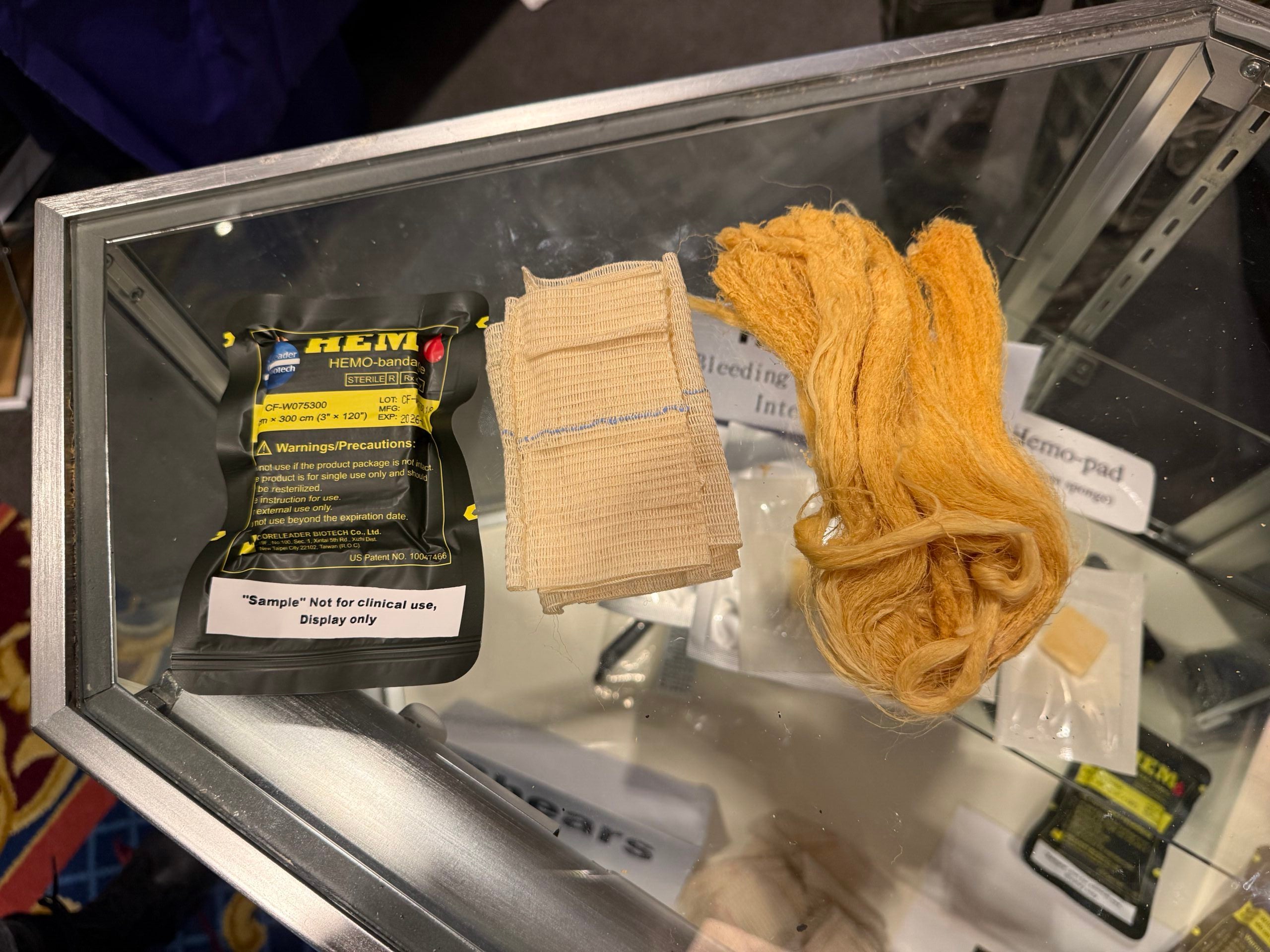
![Coreleader Biotech: HEM Hemp-Bandage for Bleeding Control [SHOT 2026]](https://www.outdoorhub.com/wp-content/uploads/sites/2/2026/01/HEM-bandage-scaled-e1769289571564.jpeg)
At SHOT Show 2026, where tourniquets and trauma kits are nothing new, it takes something genuinely different to stop you mid-aisle. One of those moments came while talking with Coreleader Biotech, an international medical technology company out of Taiwan that is approaching hemorrhage control from a fundamentally different angle.
Coreleader Biotech has developed a bleed-control gauze called Hem Hemo-bandage, made entirely from chitosan, a naturally derived material long studied for its hemostatic properties. What makes this product stand out is not simply the ingredient itself, but how it is used. Most hemostatic gauze on the market relies on a traditional fabric substrate with a clotting agent added or coated onto it. Coreleader’s process eliminates that middle layer altogether—the hemostatic agent is the gauze.
From a practical standpoint, this matters. By manufacturing the gauze entirely from chitosan, the material maintains consistent hemostatic properties throughout its structure rather than relying on surface adhesion. The result is a dressing designed to actively participate in clot formation instead of serving as a passive carrier. On the show floor, the company emphasized that this manufacturing approach was the core innovation—not a reformulation of existing gauze, but a rethinking of what the base material itself should be.
This chitosan gauze is not just a lab concept. It is currently in use by the Taiwanese military, where it has reportedly shown excellent real-world results in controlling bleeding. Military adoption often signals that a product has passed meaningful performance thresholds under demanding conditions, particularly when it comes to trauma care where seconds matter and failure is not an option.
From an application perspective, the implications are clear. A gauze that integrates hemostatic function directly into its structure could offer advantages in durability, consistency, and ease of use for military, law enforcement, and emergency medical settings. It also raises interesting possibilities for wilderness medicine and remote response, where simplicity and reliability are critical.
That said, Coreleader Biotech was appropriately measured in its messaging. While results from military use are promising, broader adoption—particularly across international civilian markets—will likely depend on additional studies and regulatory pathways. Expansion takes time, especially in medical devices, and the company appears focused on letting data lead the way.
SHOT Show is often about incremental improvements. Coreleader Biotech’s Hemo-bandage felt different—not louder or flashier, but quietly disruptive. It’s the kind of innovation that doesn’t shout from the booth, but once you understand it, you realize it may represent a meaningful step forward in how we think about bleeding control.


Trending Products