
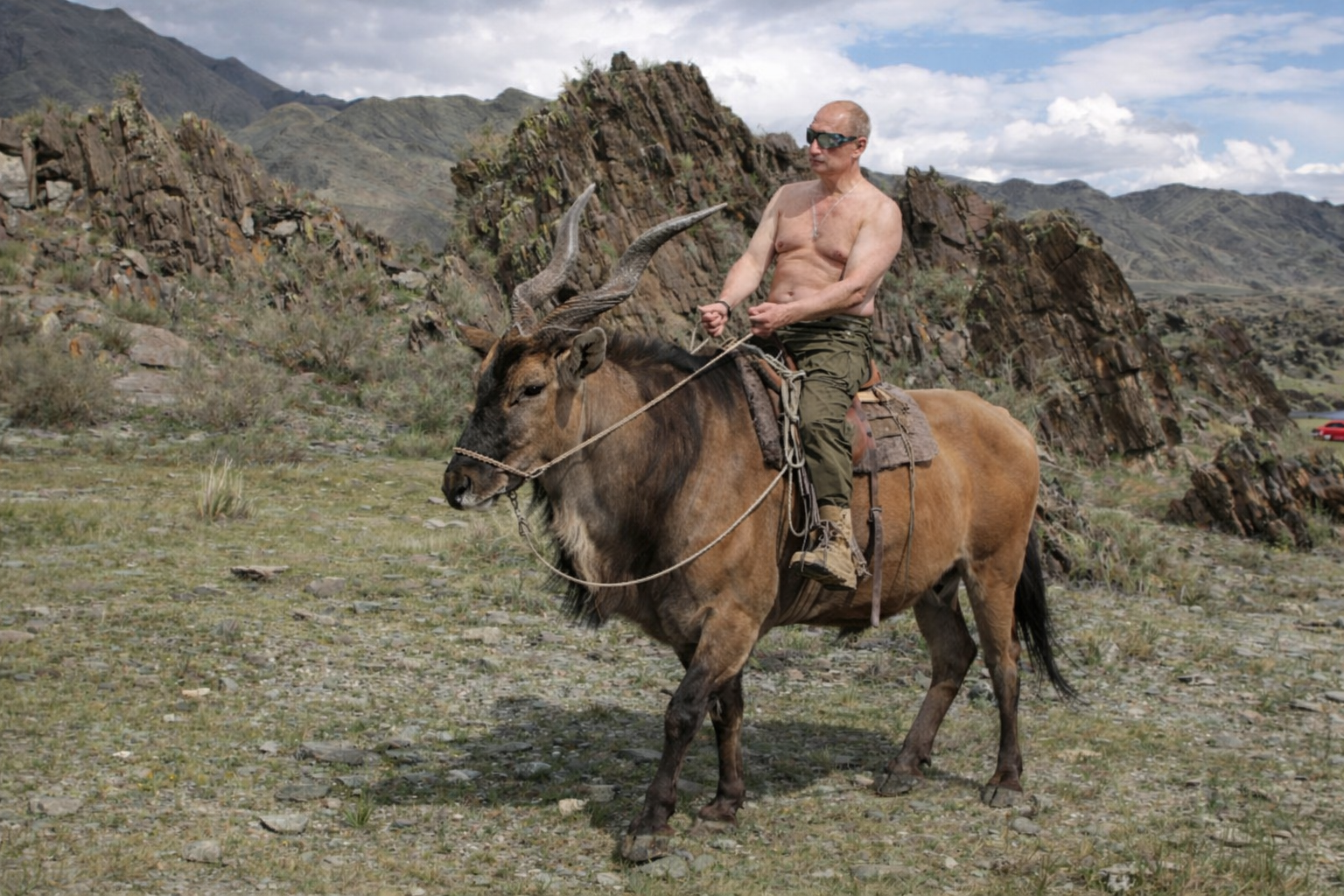

Throughout the 20th century, the Soviet Union pursued some unusual agricultural experiments in its effort to feed a massive population and make marginal land productive. One of the strangest and most fascinating involved a massive African antelope called the giant eland. Soviet scientists believed this powerful wild animal could someday replace traditional cattle across parts of the USSR.
It sounds like a Cold War fever dream, but the experiment actually happened. For decades, Soviet researchers worked to domesticate eland and test whether they could become a practical livestock animal.
What Is a Giant Eland?
The giant eland (Taurotragus derbianus) is the largest antelope species on Earth. Mature bulls can weigh well over 1,500 pounds and stand nearly six feet tall at the shoulder. They carry long spiral horns and have a heavy, muscular frame that makes them look more like a cross between a deer and a steer.
The image below was taken after several hours of stalking through the Limpopo bushveld during a plains game hunt in South Africa when we finally closed the distance on a mature giant eland bull.

Native to parts of Central and West Africa, eland are known for a few traits that caught the attention of Soviet agricultural planners.
They are:
• Extremely hardy
• Able to thrive on sparse forage
• Resistant to many diseases that affect cattle
• Capable of surviving in harsh climates
Soviet agricultural scientists believed the giant eland could potentially replace cattle in regions where traditional livestock struggled to survive.
Eland Hunting
For hunters, the eland is one of Africa’s most impressive plains game animals and also one of the most challenging to hunt successfully. Mature bulls can weigh over 1,500 pounds and have an uncanny ability to disappear into thick bush despite their size. Their keen eyesight, excellent sense of smell, and tendency to travel long distances mean that most successful hunts involve long stalks through the bushveld rather than simple spot-and-shoot opportunities.
I’ve had the privilege of being around several eland hunts in South Africa. On one trip I served as an observer while a hunting partner pursued a mature bull, and the experience alone was enough to make me appreciate just how tough these animals are. Later I had the opportunity to harvest an eland bull of my own, an accomplishment that remains one of the highlights of my time hunting in Africa.
The Savage 110 Ultralite Elite proved to be an excellent choice for African plains game. Lightweight rifles become incredibly valuable after several days of long stalks through the bushveld, and this setup delivered the accuracy and reliability needed to take a mature giant eland bull in Limpopo Province.

You can read about the Eland hunt I joined below:
The Soviet Domestication Experiment
One of the most famous locations involved in this project was the Askania-Nova Biosphere Reserve. Founded in the late 1800s and later incorporated into Soviet scientific programs, the reserve became a hub for experiments involving exotic ungulates.
Starting in the mid-20th century, researchers imported eland and began breeding them in controlled herds. The goal was straightforward: determine whether the animals could be domesticated the way humans domesticated cattle, sheep, and goats thousands of years earlier.
Scientists discovered several promising traits.
Eland adapted well to captivity and could tolerate cold winters far better than expected for an African species. Their digestive systems also allowed them to process rough forage efficiently, meaning they required less intensive pasture than cattle.
Researchers also began experimenting with milking them.
Eland Milk Was Surprisingly Valuable
One of the biggest surprises of the program was the quality of eland milk.
Eland milk turned out to be extremely rich. Compared to cow’s milk, it contained higher levels of fat and protein while also having strong antimicrobial properties that allowed it to stay fresh longer.
For researchers trying to maximize food production, that was a big deal.
Reports from the time suggested eland milk could remain usable significantly longer without refrigeration, which was attractive in remote areas where cold storage infrastructure was limited.
Why It Never Replaced Cattle
Despite promising results, eland never became a mainstream livestock animal.
There were several major obstacles.
First, eland are naturally skittish and far less docile than cattle. Handling them safely required specialized enclosures and experienced handlers. Even animals born in captivity retained strong wild instincts.
Second, reproduction rates were slower than cattle. Eland generally produce fewer calves and mature more slowly, which limits herd growth.
Finally, the infrastructure of global agriculture already revolved around cattle. Changing that system would have required enormous investment with uncertain payoff.
By the late Soviet period, the idea of replacing cattle with antelope had largely faded.
The Legacy of the Experiment
Interestingly, the experiment wasn’t a complete failure.
Herds of semi-domesticated eland still exist today in several research facilities and wildlife parks. In some places, they are raised in limited numbers for meat or dairy production.
The idea of alternative livestock is also seeing renewed interest around the world. Researchers are again looking at hardy wild ungulates that can thrive in environments where traditional cattle struggle.
For hunters and wildlife enthusiasts, the story is a reminder of just how adaptable large ungulates can be. The giant eland is already one of Africa’s most impressive plains game species. For a brief moment in the 20th century, scientists thought it might also become the world’s newest farm animal.
It never quite worked out that way, but the experiment remains one of the more unusual chapters in agricultural history.
Frequently Asked Questions About Eland
Did the Soviet Union really try to domesticate eland?
Yes. Soviet researchers experimented with breeding and milking eland at the Askania-Nova Biosphere Reserve in Ukraine during the mid-20th century. Scientists believed the giant eland’s hardiness, ability to survive on sparse forage, and resistance to certain diseases could make it a viable alternative to cattle in harsh climates across parts of the Soviet Union.
Why were eland considered as livestock?
Eland attracted the attention of agricultural researchers because they are extremely resilient animals capable of thriving in environments where traditional cattle struggle. They can survive on poor-quality forage, tolerate wide temperature swings, and produce rich milk with high fat and protein content. These traits led Soviet scientists to experiment with raising eland as a potential livestock species.
Is eland meat eaten today?
Yes. Eland meat is widely considered excellent table fare and is eaten throughout parts of Africa where the species is native. The meat is lean, high in protein, and often compared to premium venison or beef in flavor. In some areas, eland are also ranched for meat production, although they are far less commonly farmed than traditional livestock.
What does it cost to hunt an eland in Africa?
The average cost to hunt an eland in Africa typically ranges between $2,000 and $4,500 for the trophy fee depending on the country, outfitter, and quality of the bull. Most hunts take place in South Africa, Namibia, or Zimbabwe as part of a plains game safari package. When daily rates, travel, and other species are included, a full plains game hunt that includes an eland often runs between $7,000 and $15,000 total.
Can you hunt eland in the United States?
Yes. Eland can be hunted on certain large exotic game ranches in Texas where free-ranging or high-fence populations exist. Prices vary widely depending on the ranch and the size of the bull, but most eland hunts in the U.S. typically range from $3,000 to $8,000. While these hunts are very different from pursuing eland in Africa’s bushveld, they offer hunters an opportunity to harvest the largest antelope species in the world without international travel.
What is the best caliber for hunting eland?
Eland are large and durable animals that can weigh over 1,500 pounds, so most professional hunters recommend medium-to-large caliber rifles capable of deep penetration. Popular choices include the .300 Winchester Magnum, .338 Winchester Magnum, and .375 H&H. Many hunters consider the .300 Win Mag an excellent all-around caliber for plains game safaris because it provides the power needed for large animals like eland while still being versatile enough for smaller species.

Ben currently leads the editorial staff for Outdoorhub, Alloutdoor, and The Firearm Blog. He is an avid outdoorsman and has hunted for large game across the United States including Alaska, Texas and his home state of Michigan.
Ben also has a deep knowledge and passion for firearms and has participated in various civilian courses focusing on precision rifle shooting, carbine, pistol, ammunition reloading, and hunting focused firearm applications.
Outside of work, Ben pursues a number of water based activities spending his free time in Northern Michigan boating and fishing on Lake Charlevoix and Lake Michigan.

Trending Products