

Between 7,000 and 8,000 people are bitten by venomous snakes in the United States every year. Fatalities are rare, averaging around five per year nationally, but the consequences of a serious bite can be painful, prolonged, and financially devastating. As warm weather returns and people spend more time outdoors, knowing which snakes to watch for, where encounters are most likely to happen, and how to respond can make a real difference.
The South accounts for roughly 82% of all venomous snake bites in the country, followed by the West at 11%. That said, venomous snakes are found in every state except Hawaii, Maine, and Alaska, so no region is entirely free of risk.
North Carolina leads the nation in bites per capita at 157.8 per million residents, more than five times the national average. Other high-incidence states include West Virginia, Arkansas, Oklahoma, Virginia, and Texas. Texas, home to approximately 68 species of snakes including 15 considered potentially dangerous, records 44.2 bites per million people annually. Three southern states, Texas, Florida, and Georgia, account for 44% of all venomous snake bite deaths nationally.
Arizona stands apart for its rattlesnake diversity, with greater than 12 venomous rattlesnake species, more than any other state. Between 250 and 350 snake bites are recorded there each year, roughly 200 of them from rattlesnakes. The Western Diamondback is the most common culprit and regularly turns up in residential yards across the Phoenix area. New Mexico is home to 50 snake species, eight of them venomous, including the Western Diamondback, Mojave rattlesnake, black-tailed rattlesnake, and Western coral snake.
In the South, the copperhead is responsible for more bites than any other venomous species in the country, biting more people than all other venomous snakes combined. The cottonmouth, also called the water moccasin, is the dominant threat near water throughout the region. Rattlesnakes, including the timber rattlesnake and the Eastern diamondback, account for most of the serious injuries and deaths.
Trails are one of the most common settings for snake encounters, particularly where paths pass through tall grass, rocky terrain, leaf-covered ground, or dense vegetation near water. Snakes use trails and trail edges for the same reason hikers do: they are open, relatively clear corridors. A snake resting in leaf litter along a trail edge is easy to step on without ever seeing it, which is exactly how the majority of accidental bites happen.
Waterways are another high-risk environment. Cottonmouths are semi-aquatic and are found throughout Southern rivers, lakes, swamps, and marshes. Kayakers and canoeists face a particular hazard from snakes sunning on branches that overhang the water, a scenario that played out in Florida when a man was bitten by a cottonmouth during a kayaking trip on his honeymoon. What followed was a prolonged medical ordeal that eventually led to stage 4 lung disease and the need for a double-lung transplant, a stark reminder that even bites from snakes with comparatively modest venom can, in some cases, cause lasting systemic damage.
Around the home, snakes are most often encountered in woodpiles, tall grass, garden beds, and areas where debris has accumulated. They follow prey, so anywhere mice and rats are present, snakes are likely nearby.
In terms of timing, snake activity in the South and Southwest peaks between April and October. In spring, snakes are diurnal, most active during the day as they warm up after winter dormancy. As summer temperatures rise, many species shift to crepuscular or nocturnal activity, becoming most active at dusk and overnight. Late summer also brings juvenile snakes as many species give birth between July and August. Young snakes are small and easy to miss underfoot, but they are born with fully functioning venom. About half of all venomous snake bites nationally occur on weekends, when people are most likely to be outdoors in recreational settings.

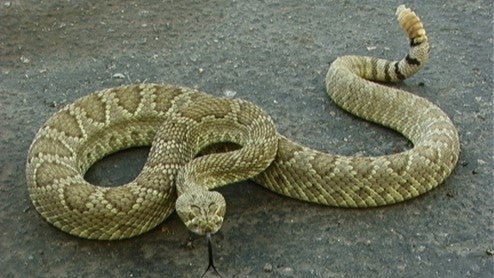
Most venomous snakes in North America, including rattlesnakes, copperheads, and cottonmouths, are pit vipers. They share several identifying features: a triangular or arrow-shaped head noticeably wider than the neck, a heavy body relative to overall length, elliptical or slit-like pupils, and heat-sensing pits located between the eye and nostril on each side of the face. Rattlesnakes have the additional identifier of a rattle at the tail, though young rattlesnakes may have only a small button that is easy to miss.

The coral snake is the major exception to these characteristics. It has a slender body, a rounded head, and round pupils with no facial pits. In the United States, coral snakes are identified by their distinctive banding pattern of red and yellow rings that touch each other, with black rings separating each pair. The familiar rhyme applies here: red touches yellow, kill a fellow; red touches black, friend of Jack. That said, wildlife experts consistently point out that if you need a rhyme to decide whether to pick up a snake, the answer is always to leave it alone.

Several non-venomous species mimic venomous ones, which leads to many harmless snakes being killed unnecessarily. Non-venomous water snakes are frequently mistaken for cottonmouths. The key behavioral difference is that a cornered cottonmouth will often hold its ground and gape its mouth open, exposing the white interior that gives it its name, while non-venomous water snakes almost always flee toward water when approached. Some non-venomous species also flatten their heads or vibrate their tails in dry leaves to mimic a rattlesnake. When in doubt, keep your distance.
One snake worth knowing by sight is the kingsnake. Non-venomous, immune to the venom of copperheads and rattlesnakes, and an active predator of venomous species, the kingsnake is genuinely beneficial. Encountering one in a yard or on a trail is a good sign, not a reason for alarm.

The most important thing to understand about snake bite first aid is that many common folk remedies are not just ineffective, they can actively make the situation worse. The priorities are simple: get away from the snake, stay calm, and get to an emergency room as fast as possible.
Do These Things
- Move away from the snake immediately. Do not attempt to catch, kill, or handle it.
- Call 911 or get to an emergency room as quickly as possible. Treat every bite as a medical emergency.
- Stay as calm and still as possible. Movement speeds the spread of venom through the body.
- Keep the bitten limb at or slightly below heart level.
- Remove rings, watches, and tight clothing near the bite before swelling begins.
- If it is safe to do so, photograph the snake from a distance. Identifying the species helps emergency staff select the right antivenom.
Do Not Do These Things
- Do not apply a tourniquet. Restricting blood flow concentrates venom in the tissue and can cause severe damage or limb loss.
- Do not apply ice. Cold causes blood vessels to constrict and dramatically worsens tissue injury from venom.
- Do not cut the bite or attempt to suck out venom, by mouth or with a commercial suction kit. Neither works and both introduce new risks.
- Do not drink alcohol, caffeine, or take aspirin or ibuprofen. These increase bleeding and worsen the body’s response to venom.
- Do not wait to see if symptoms worsen. Even if a bite feels minor, approximately 20% of rattlesnake bites involve no venom injection at all, known as a dry bite, but there is no reliable way to determine this outside a clinical setting.
Anti-venom is the only definitive treatment for venomous snake bites. It is most effective when administered quickly, and patients are typically monitored for 18 to 24 hours following treatment. Hospital costs for serious bites can be severe. In Arizona, the average bill for a rattlesnake bite exceeds $100,000, with antivenom alone running thousands of dollars per vial and some patients requiring 18 or more vials. Understanding your health insurance coverage before spending time in high-risk areas is worthwhile.
The most effective prevention strategy is to leave every snake you encounter alone. The majority of venomous bites in the United States are provoked, meaning they happen when someone tries to handle, move, or kill the snake. A snake that is simply given space will almost always move on without incident.
When hiking or spending time outdoors in snake active areas, watch where you step and where you place your hands. Snakes rest under logs, in rock crevices, beneath leaf litter, and along trail edges, all places where a person’s hand or foot might land unexpectedly. Wear boots and long pants on trails, stay on marked paths where possible, and be especially cautious near water. Carry a charged phone and let someone know your route and expected return when heading into remote areas.
Around the home, keep grass trimmed short and clear away brush piles, woodpiles, and debris that provide ideal shelter for snakes and the rodents they follow. Seal gaps in foundations and around pipes. If a snake turns up somewhere unwanted, spraying it gently with a garden hose from a safe distance will usually encourage it to move along on its own. Pets should be kept on leashes in snake active areas, as dogs in particular tend to investigate exactly the kinds of spaces where snakes shelter.
Sources
- MySuncoast / WWSB, Sarasota, FL, March 2026: Suncoast couple seeks help after snake bite leads to stage 4 lung disease, need for double lung transplant
- WorldAtlas: 8 Snake-Infested State Parks in the Southern United States
- Outdoor Alabama / Alabama Department of Conservation and Natural Resources
- Alabama Cooperative Extension System: Identification and Control of Snakes in Alabama
- World Animal Foundation: Snake Bite Statistics by State 2026
- PMC / NCBI: The T’s of Snakebite Injury in the USA (2019)
- CDC / NIOSH: Venomous Snakes, A Neglected Hazard for Outdoor Workers
- CBS News: Snakebites are on the rise, and these states are the riskiest
- 12News / KGUN9 (Arizona): Rattlesnake bite treatment costs
- University of Utah Health Poison Control: Antivenom for Rattlesnake Envenomation (2024)
- Mayo Clinic: Snakebites First Aid
- Johns Hopkins Medicine: Snake Bites
- Asclepius Snakebite Foundation: How to Survive a Snakebite in the Wilderness


Trending Products