
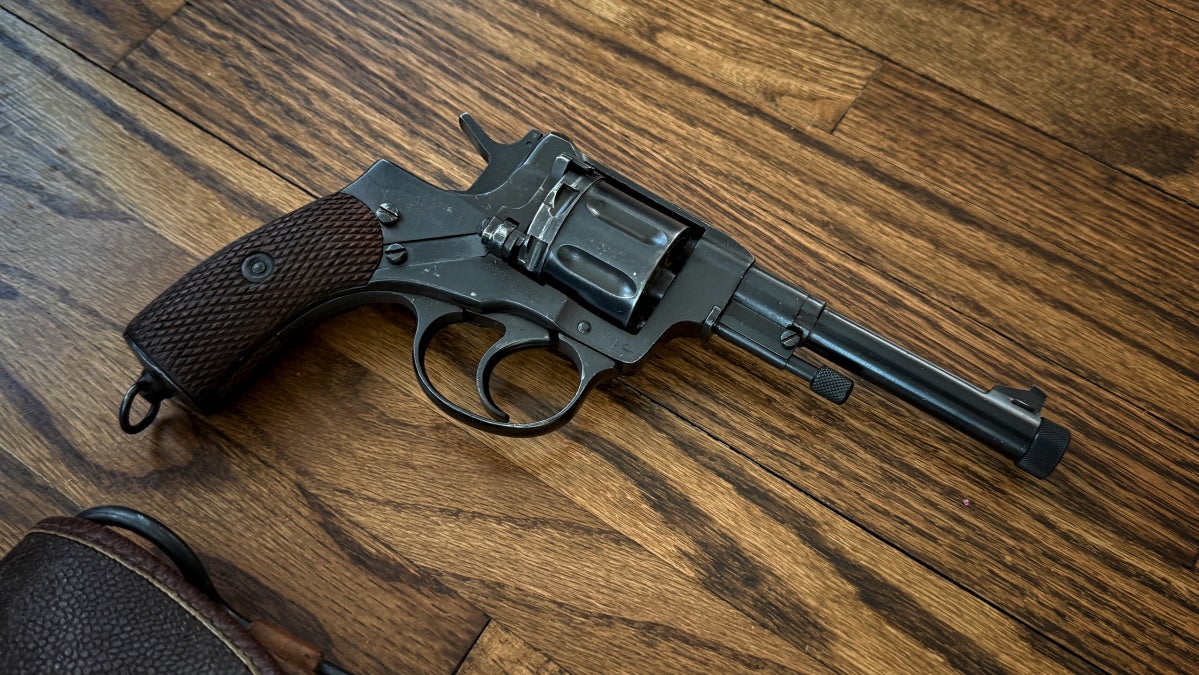

Welcome, if you are a newcomer to this fun bi-weekly segment of AllOutdoor.com! The last time around we closed out our four-part run covering the M1 Carbine. Today we are kicking off something completely different and heading back across the Atlantic. Ladies and gentlemen, today we are starting coverage of the Nagant 1895 revolver. A Belgian-designed, Russian-issued, seven-shot gas-seal wheel gun that was considered outdated the day it was adopted and somehow kept going for the better part of a century anyway. Let’s dive right into the rabbit hole!
Curious Relics Coverage on AllOutdoor
Welcome to our recurring series of “Curious Relics.” Here, we want to share all of our experiences, knowledge, misadventures, and passion for older firearms that one might categorize as a Curio & Relic – any firearm that is at least 50 years old according to the ATF. Hopefully along the way you can garner a greater appreciation for older firearms like we do, and simultaneously you can teach us things as well through sharing your own expertise and thoughts in the Comments. Understanding the firearms of old, their importance, and their development which lead to many of the arms we now cherish today is incredibly fascinating and we hope you enjoy what we have to share, too!
History Abridged: Nagant 1895
By the early 1890s Russia wanted a new sidearm. The standard-issue Smith and Wesson No. 3 “Russian” was a top-break single-action revolver in 11mm black powder (44 Russian) and it had served well enough, but top-break revolvers are fragile. Years of hard field use across thousands of men wore them out. On top of that, Russia had just adopted the Mosin-Nagant rifle in 7.62mm and was firmly in the smokeless powder era. The sidearm needed to catch up. Belgian brothers Emile and Leon Nagant already had an established relationship with Russian ordnance through their contributions to the Mosin-Nagant rifle magazine, and when Russia’s arms commission went looking for a new revolver, the Nagant firm answered with a gas-seal design.

When the hammer is cocked, the cylinder moves forward and the mouth of a specially designed cartridge seals against the rear of the barrel. That gap that bleeds pressure on every other revolver ever made? Gone. The result is a modest velocity boost and, as a notable side effect, the ability to effectively suppress the revolver – something virtually no other revolver can do. Russia adopted it on May 13th, 1895. Initial production ran out of Liege, Belgium, and by 1898 Russia purchased the manufacturing rights and moved everything to the Tula Arsenal. Two versions were made from the start: a double-action model for officers and a single-action-only model for enlisted men.

Early Belgian production from 1895 to 1898 amounted to roughly 20,000 revolvers. Tula got rolling in 1899 and ramped fast. The Nagant first saw real field use during the Boxer Rebellion in China in 1900, where Russian troops including Lieutenant Stanevich of the 12th Siberian Regiment reportedly used one while breaching a room and taking out two enemy soldiers. Not a bad debut.
The Russo-Japanese War of 1904 to 1905 was a rougher story. Russia was soundly beaten and the Nagant took its share of the blame. Cavalry hated it. Reloading a gate-fed revolver at a trot took 56 seconds, at a walk 44 seconds. The Smith and Wesson’s top-break simultaneous extraction was starting to look pretty good by comparison. Production shot back up significantly in 1905 as Russia scrambled to replenish losses. By the end of the conflict the Nagant had earned a mixed but livable reputation. Rugged, reliable, and accurate. Slow to reload and lightly powered, but it kept running.

Production figures for the Nagant vary depending on the source and some of the most detailed numbers available come from forum research rather than official documentation, so take specific totals with appropriate skepticism. From what I have read, total production by January of 1914 sat at around 574,000 Nagants.
World War One changed everything. When the Great War exploded into a scale no one had planned for, Russia needed handguns badly. Production climbed sharply through 1914 and peaked somewhere around 130,000 per year in both 1915 and 1916 before dropping back as revolution ground things to a halt in 1917. Workdays stretched to 12 hours. Workers got three days off a month. Inspection standards got loosened to keep guns moving. Nagants were issued to officers, NCOs, signal troops, cavalry, artillery crews, and machine gun teams. As the fighting moved into closer quarters, they also ended up in the hands of shock troops and grenadiers. By the time the revolution hit in late 1917, sources estimate roughly 1.05 million Nagants had been produced.

The revolution complicated things but did not stop production. It is worth noting that the Nagant had been personally approved for adoption by Tsar Nicholas II back in 1895. It was also a Nagant that was used to execute him and his family in July of 1918. Both the Reds and the Whites carried this gun through the Civil War, which probably tells you everything you need to know about how ubiquitous it was. Tula kept turning them out under Bolshevik control. Old Tsarist markings were ground off existing frames and the arsenal stamp went through several changes over the following years as the government reorganized itself, eventually settling into Soviet markings by 1924. That same year the Nagant revolver was designated an honorary revolutionary weapon, the highest award in the Soviet Armed Forces for senior commanders. As for the single-action-only model, from what I have read it appears to have faded out around 1918, though I could not nail down an exact cutoff date with certainty. From that point on, production was double-action only.

The Nagant also became the firearm of choice for the Soviet secret police. The Cheka, which later became the OGPU and then the NKVD, carried Nagants widely in their internal security and political enforcement work. It was frequently seen with a shortened barrel for plainclothes concealment. Since the gas-seal design eliminates the cylinder gap, the Nagant can be effectively suppressed, and the Soviets put this to use early on. A suppressor device known as the Bramit, named after its designers the Mitin brothers, was developed in the early 1930s specifically for the Nagant. Scout and reconnaissance troops used them in the field during World War Two, and the NKVD and later the KGB put suppressed Nagants to use in political killings and clandestine operations for decades afterward.

Output started to drop as the TT-30 Tokarev semi-automatic pistol arrived in 1930. The Tokarev was the Nagant’s intended replacement – modern, fast to reload, and chambered for the hard-hitting 7.62x25mm Tokarev cartridge. But the Tokarev had teething issues and could not fill the gap fast enough, so Nagant production simply kept running alongside it through the 1930s.
By 1941 Tula was still turning out around 118,000 Nagants per year. Then in October of 1941, German forces advanced within a few kilometers of Tula and the factory had to evacuate. Nagant production relocated to Izhevsk while a second line was eventually stood back up at a new Tula facility. Getting a revolver’s timing right requires precision and experience, and the new workers at both locations did not have it. Quality suffered badly through 1942 and into 1943. Rejection rates at the Tula line at one point reportedly exceeded 700%. The average number of cartridges fired per revolver during proof testing in late 1943 was around 33 rounds, more than the thing was likely to ever fire in combat. Some workers were caught resubmitting rejected revolvers hoping inspectors would miss them. At one point a group duplicated an inspector’s approval stamp and started marking their own rejects. It was a mess. Izhevsk got its footing first and output improved steadily through 1944. By mid-1945 both locations had stopped production. WWII total production from both is estimated at around 370,000 revolvers, bringing the all-time total to approximately 2.6 million guns across fifty years.

After the war the Soviets formally retired the Nagant from front-line Army service. The Makarov pistol arrived in 1952 and that was supposed to close the chapter. It did not quite. Nagants showed up in Chinese and North Korean hands during the Korean War. Suppressed examples turned up with Viet Cong guerrillas during the Vietnam War, used as assassination tools. A suppressed Nagant 1895 is on display at the CIA Museum in Langley, Virginia today, which tells you something about how far this gun traveled from its origins as a Tsarist sidearm.
Back in the Soviet Union the guns were overhauled rather than scrapped. During the 1960s and into the 1970s, large numbers went through arsenal refurbishment. They were cleaned up, refinished, and had worn parts replaced. Grips on most surviving examples were swapped out for plastic panels. Any remaining single-action examples got converted to double-action, and any remaining half-moon front sights were updated to the stepped style. The vast majority of Nagants you run into in American collections today are in this refurbished configuration, which is why so many look surprisingly clean for guns that are 70 to 100 years old.

After the Soviet Union collapsed, military surplus flooded international markets. Nagants hit the American market in quantity in the late 2000s, selling for around a hundred dollars with a synthetic holster. They were import marked and almost universally refurbished, but they were a great value for what they were. That window did not last long. The supply dried up and prices have been climbing since. At the time of writing, shooter-grade refurbished examples tend to run somewhere in the low hundreds on up, while clean original unrefurbished examples with desirable proof marks can push well past $1,000. I would check current GunBroker listings before buying or selling since the market on these has been moving.

End of Part One: Nagant 1895
Well folks, that wraps up the history on this one. A gun that nobody loved, that everybody complained about, that kept showing up because there was always a war on or a budget shortfall or two million of them already in the warehouse. Next time we will get into the variations between the officer and soldier models, Belgian versus Tula production differences, Soviet-era changes, the short-barrel variants, and the sport and target models that came out of Tula over the decades. Till then keep an eye out, and I hope to see you back here soon!

In closing, I hope our Curious Relics segment informed as well as entertained. This all was written in hopes of continued firearm appreciation and preservation. We did not just realize how guns were supposed to look and function. It was a long and tedious process that has shaped the world we live in. So, I put it to you! Is there a firearm out there that you feel does not get much notoriety? What should our next Curious Relics topic cover? As always, let us know all of your thoughts in the Comments below! We always appreciate your feedback.

Trending Products