
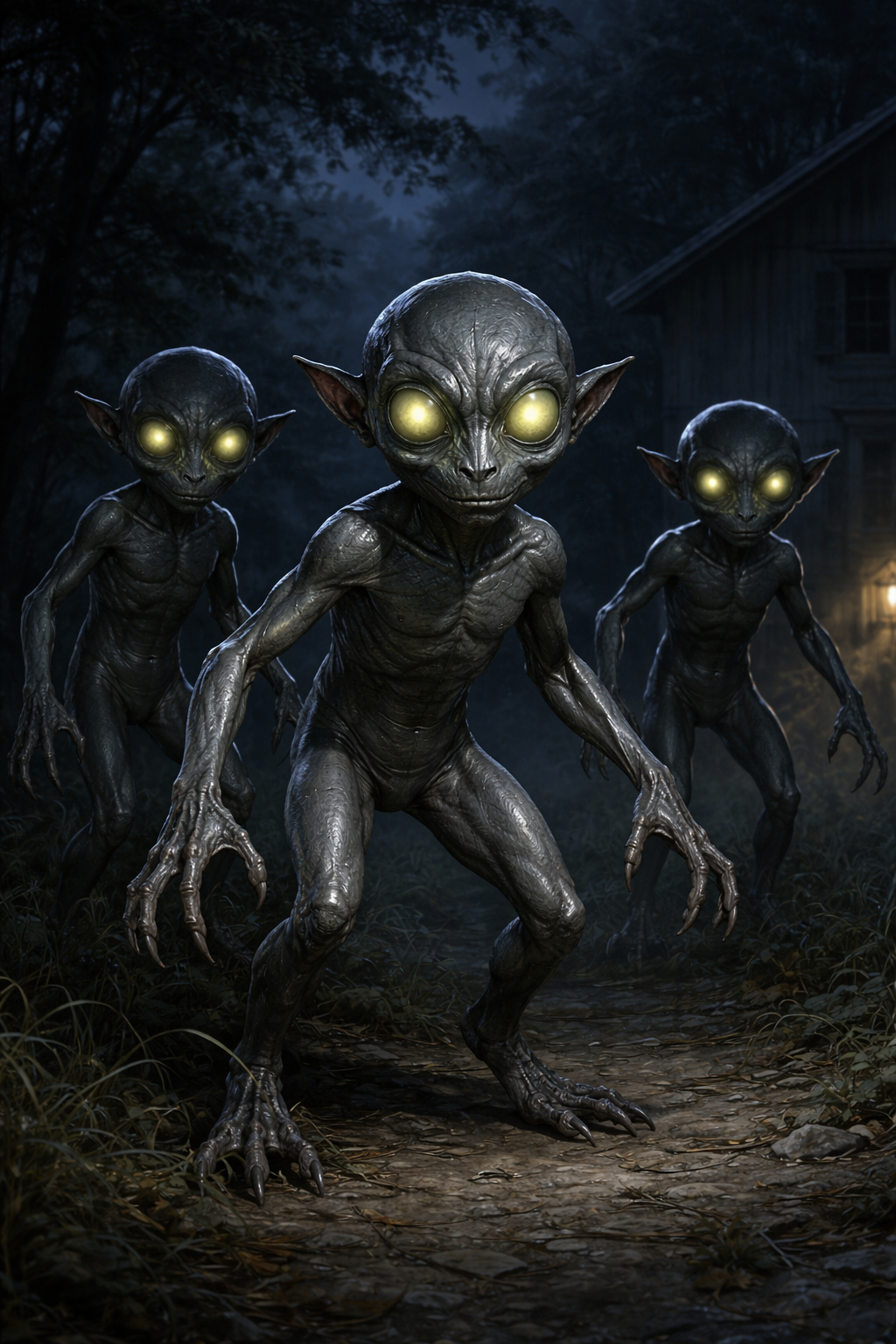

Background of the Hopkinsville Goblins
On August 21, 1955, just outside Hopkinsville near the tiny community of Kelly, a farmhouse gathering turned into one of the most documented close encounter cases in American UFO history.
The Sutton family and several visitors reported seeing a luminous object streak across the evening sky and descend into a nearby field. Within the hour, small humanoid figures began emerging from the tree line. Over the course of several hours, the beings allegedly approached the home repeatedly and began peering through windows, climbing onto the roof, and standing silently in the yard.
Local police responded to the farmhouse that night, followed by military personnel from nearby bases. The event was later reviewed under Project Blue Book, the U.S. Air Force’s official UFO investigation initiative from 1952 to 1969. While the Air Force did not conclude extraterrestrial involvement, the case was preserved in official files and remains one of the most thoroughly documented civilian encounters of its era.
Unlike fleeting lights in the sky, this was a prolonged, ground-level interaction. That distinction is part of what keeps the Hopkinsville Goblins alive in UFO lore.

Physical Description and Alleged Behavior
Witnesses described the creatures as approximately three to four feet tall with oversized, rounded heads and luminous eyes that reflected light intensely. Their skin was often described as having a metallic or silvery sheen. Their arms appeared elongated, extending almost to the knees, ending in claw-like hands.
Their movement is what unsettled witnesses most. Rather than walking in a natural human stride, they were said to glide or float, sometimes flipping backward when struck by gunfire. According to accounts, shotgun blasts appeared to knock them down but left no visible blood or lasting injury. The beings would retreat into the darkness only to reappear minutes later.
They did not roar or attack in a traditional predatory way. Their actions seemed observational—advancing cautiously, retreating, returning. That pattern has led many UFO researchers to categorize the event as a “close encounter of the third kind,” terminology later popularized by J. Allen Hynek, who consulted for Project Blue Book.
Hopkinsville Goblins Habitat and Where They’re Spotted
The encounter took place in open farmland bordered by woods and rolling fields—terrain that provides natural concealment and wide visibility. Rural Kentucky in the 1950s had minimal light pollution, making aerial phenomena more visible and nighttime shadows deeper and more absolute.
Although there have not been repeated mass sightings of similar beings in Hopkinsville, the region remains synonymous with the event. The town embraces its history through events like GoblinCon UFO and Paranormal Expo, where researchers, enthusiasts, and curious travelers gather annually to revisit the mystery.
The Hopkinsville case is also frequently referenced in broader UAP discussions reviewed by modern defense offices such as the Pentagon’s All-domain Anomaly Resolution Office (AARO), though no official documentation confirms extraterrestrial origins.

If I Were to Hunt the Hopkinsville Goblins, What Should I Use?
If someone were to attempt to pursue a repeat encounter under modern conditions, they would first, have to revisit the area where the sighting originally occurred and attempt to find some sort of clues that had been left behind and preserved. Newspapers would have to be combed through, documents searched. If a lead were to be found then one could proceed to begin a hunt.
First, visibility is everything. A layered optics approach would be essential:
-
High-end thermal imaging scopes to detect heat signatures
-
Digital night vision systems with recording capability
-
Motion-triggered trail cameras positioned along treelines
-
360-degree perimeter surveillance drones operating at low altitude
Unlike the 1955 witnesses, modern investigators could triangulate movement using synchronized sensors. If these beings reflect light intensely, as reported, low-lumen red illumination might minimize detection while preserving operator concealment.
Ballistics are a different question. The original witnesses used shotguns, claiming impact without injury. If the creatures possess unusual dermal resilience or if their “metallic” appearance indicates reflective or armor-like tissue then traditional ammunition might be ineffective.
If the goal were capture rather than eliminate, non-lethal containment tools would be wiser, especially if you consider reports that shotguns seemingly had no effect. Tools like reinforced drop nets, electrified containment cages, EMF monitoring equipment to track anomalous field disruptions, and Faraday-lined transport units in case of electromagnetic interference.
Communication gear would be mandatory. If the beings operate in coordinated groups, a lone hunter would be outmatched. A small team with overlapping sightlines, encrypted radios, and designated fallback positions would be safer. A clear plan of action and communication would be key.
And perhaps most importantly: documentation. Body cams, environmental sensors, and live telemetry would matter more than firepower. In a case like this, proof would be the true trophy.

Is the Hopkinsville Goblin Edible, and How Would I Prepare It?
Speculating on the edibility of a potentially extraterrestrial organism ventures into biological uncertainty. If the metallic sheen described by witnesses were superficial, the underlying tissue might resemble something terrestrial. But if the organism evolved in a radically different environment—silicon-based chemistry, for example—consumption could be hazardous.
I don’t think anyone would be jumping at the chance to try and cook an extraterrestrial being if they were so lucky to catch one. Normally, I like to entertain the ideas of what other cryptids might taste like and how they could be prepared, but cooking and eating an alien seems like a bit much.
In truth, if you harvested a Hopkinsville Goblin, the smartest preparation would likely involve a research facility.
Modern Sightings and Pop Culture Influence
The Hopkinsville encounter has had outsized influence on alien imagery in American culture. The description of small humanoids with large eyes predates the now-iconic “grey alien” description that most are familiar with.
In 1977, Steven Spielberg introduced the world to benevolent extraterrestrials in Close Encounters of the Third Kind—a title borrowed directly from Hynek’s classification system. The film’s alien design, with large eyes and small frames, echoes elements described in Hopkinsville.
The encounter has also been referenced in documentaries such as The Mysterious Monsters and more recent dramatizations exploring the 1955 events. It has appeared in paranormal literature and UFO compendiums, including works discussing historic American close encounters.
Even the cultural shorthand “little green men” gained mainstream traction following this event, despite the original witnesses rarely describing the beings as green.
Today, Hopkinsville leans into the legend. Festivals, themed art, and community events ensure that the story remains embedded in local identity. Seventy years later, the goblins are less a punchline and more a permanent fixture in American extraterrestrial folklore.

Final Verdict: Myth or Monster?
Official investigations, including those under Project Blue Book, did not confirm alien visitation. Explanations ranging from misidentified owls to meteor sightings have been proposed.
Yet the length of the encounter, the number of witnesses, and the involvement of law enforcement make it more substantial than a single fleeting light in the sky.
No government file confirms extraterrestrials. No physical specimen was recovered. But the consistency of witness descriptions and the case’s endurance in official archives ensure it remains one of the most compelling close encounter accounts in U.S. history.
Closing Thoughts
The Hopkinsville Goblins endure because they trigger fear and imagination of the unknown. A rural farmhouse in Kentucky on a summer night. A flash of light across the sky. Something stepping out of the tree line.
Whether you see it as misidentification, mass hysteria, or first contact, the legend has survived generations.
If you ever find yourself beneath a Kentucky night sky near Hopkinsville, let your eyes adjust to the dark and keep watch for any extraterrestrial mysteries.



Trending Products