

In northern Minnesota, winter is not just a season; it’s a test of will and strength. It’s a place where snow stacks shoulder-high, daylight disappears early, and the forests swallow sound and distance alike. It’s in that environment that the Wendigo is said to exist, a creature shaped by hunger, isolation, and the unforgiving realities of the North.
Among hunters, trappers, and winter campers, the Wendigo isn’t dismissed outright. It’s spoken about cautiously, often indirectly, and usually by people who spend serious time in the woods when temperatures drop below zero.
Background of the Wendigo
The Wendigo legend originates with Algonquian-speaking Native American nations, most notably the Ojibwe, whose ancestral lands include much of present-day Minnesota. Unlike many European-style monsters, the Wendigo was never just a story meant to scare children; it was a warning about what happens when survival turns into obsession.
In traditional belief, the Wendigo begins as a human. During times of extreme famine, particularly brutal winters, an individual who resorts to cannibalism is said to become cursed. The transformation is gradual: overwhelming hunger, paranoia, withdrawal from the community, and eventually a complete loss of humanity. What emerges is something no longer human at all, but a creature of suffering.
For the Ojibwe and neighboring tribes, the Wendigo represented more than a creature. It embodied greed, selfishness, and imbalance with nature. In a culture built on communal survival, the Wendigo was the ultimate taboo. It was a living reminder that survival without ethics leads to destruction.
As settlers pushed north into Minnesota in the 1800s, logging camps and remote winter homesteads created conditions eerily similar to those described in Native oral traditions. Reports from this era describe men fleeing camps during winter, disappearances along frozen lakes, and individuals returning “not right,” obsessed with food and fearful of being alone.

Physical Description and Alleged Behavior
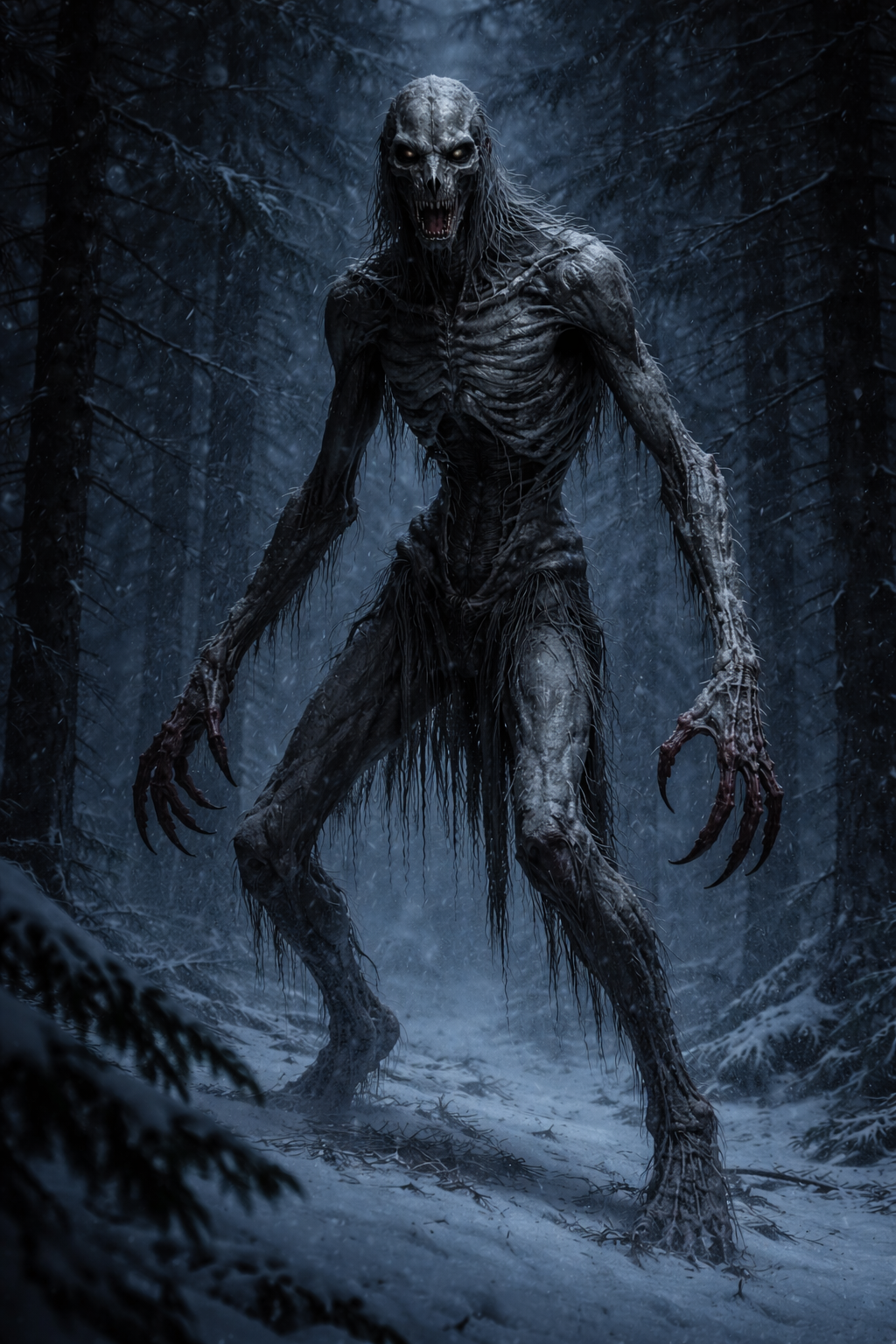
Across Minnesota accounts, the Wendigo is described with unsettling consistency. Witnesses report a tall, skeletal humanoid, often over seven feet in height, with gray or ashen skin stretched tight over bone. Its limbs appear unnaturally long, fingers ending in claw-like points. The eyes are deep-set, dark, and intensely focused.
Those who claim close encounters say the air grows colder in its presence, regardless of ambient temperature. Breath fogs instantly. Sounds dull. Wildlife goes silent.
The Wendigo is believed to be methodical rather than violent, stalking prey over long distances. It waits for exhaustion, confusion, or separation. Many stories describe it mimicking human voices, hearing calls from the tree line, using familiar tones to draw someone off trail.
It is most active during heavy snow, whiteouts, and long winter nights, when visibility is poor and help is far away.

https://supernaturalwiki.com/1.02_Wendigo
Wendigo Habitat and Where It’s Spotted
In Minnesota, Wendigo sightings and stories cluster around deep forest and lake country, particularly near Bemidji, Leech Lake, and Cass Lake.
These areas share key characteristics: dense pine cover, limited winter access, and long stretches without cell service or nearby help. The Wendigo is said to favor frozen wetlands, old logging roads, and game trails far from maintained paths.
Winter campers report strange tracks that don’t match known animals, sudden temperature drops, and the persistent feeling of being watched, especially after dark.

If I Were to Hunt the Wendigo, What Should I Use?
Hunting a Wendigo would be likened to a winter predator-avoidance operation conducted under the worst possible conditions. The creature is said to be active during deep winter, when visibility is low, temperatures are extreme, and mistakes carry real consequences. Any attempt to track it would require full cold-weather preparedness first and foremost, because the environment itself would be the greatest immediate threat.
If the Wendigo can be confronted at all, most accounts suggest that large-caliber rifles suited for elk or moose would be the only reasonable option. Penetration would matter more than speed or expansion, and no one familiar with the legend believes a single shot would be enough to stop it. Encounters are described as brief, chaotic, and disorienting, often ending not with a hurried retreat.
Traditional stories and modern wilderness experience agree on one point: a solo hunt would be a mistake. The Wendigo is said to isolate its prey, waiting for exhaustion, confusion, or separation before closing in. Moving in a small, disciplined group would provide both safety and accountability, especially in whiteout conditions where trails disappear and sound carries unpredictably.
Beyond weapons, survival gear is non-negotiable. Fire-starting tools, redundant insulation, emergency shelter, and reliable navigation would be essential, not as backup plans but as primary concerns. Many stories tied to the Wendigo end not with an attack, but with someone freezing, getting turned around, or making a desperate decision after being mentally worn down.
Among Native traditions, the strongest warning is not about firepower or gear, but intent. The Wendigo is said to be drawn to obsession, fear, and desperation. Those who go looking for it casually, out of curiosity or bravado, are believed to place themselves at risk long before they ever see anything unusual.
In the end, even hypothetically, hunting the Wendigo isn’t about proving it exists. It’s about understanding that winter in northern Minnesota is already unforgiving — and whatever else may be out there knows that terrain far better than you ever will.
Is the Wendigo Edible, and How Would I Prepare It?
Short answer: no.
In traditional belief, consuming Wendigo flesh risks inheriting its hunger and corruption. The creature is defined by endless appetite; eating it is said to bind you to the same fate.
Modern speculation treats the idea as dark humor around campfires. Hypothetically, the meat is described as bitter, tough, and unnaturally cold. Stewing or smoking would be the only plausible methods — but even discussing preparation is often considered bad luck.
Modern Sightings and Pop Culture Influence
The following is a first person account of a possible sighting:
“I was snowshoeing alone north of Bemidji, just a day loop I’d done before. The weather turned faster than expected — wind picked up, snow came down hard. That’s when I noticed the quiet. No birds. No wind noise. Just my breathing.
I heard my name once. Clear as day. Came from behind me. I turned, expecting another hiker. There was nothing. Just trees.
But the feeling didn’t go away. Every time I stopped, it felt like something else stopped too. I didn’t see it — and that somehow made it worse. I cut my trip short and moved fast. When I finally hit the trailhead, the feeling lifted like a weight.
I don’t say it was a Wendigo. I just know I wasn’t alone.”
The Wendigo entered mainstream pop culture most notably through the TV show Supernatural, where it’s portrayed as a former human transformed by cannibalism into a relentless forest predator. The show’s depiction closely mirrors traditional lore, particularly its emphasis on winter, isolation, and transformation.
Since Supernatural aired, interest in Wendigo encounters has surged. Online reports, podcasts, and regional forums frequently reference Minnesota as a hotspot for sightings, especially among winter recreationists.
The Wendigo also appears in films, novels, and video games, often serving as a symbol of what happens when survival eclipses humanity.
There is also a fictional version of the Wendigo where it is used as an icon to be emulated “Be the reason the forest is haunted” in the Wrath of the Wendigo…

Final Verdict: Myth or Monster?
To some, the Wendigo is a psychological artifact created from starvation, fear, and isolation. To others, it’s a predator adapted to the coldest, loneliest places in the North.
What’s certain is that the legend persists where conditions are harshest and mistakes are unforgiving. The Wendigo exists at the intersection of survival, morality, and is a reminder that the North doesn’t forgive greed or carelessness.

Closing Thoughts
Minnesota’s winter wilderness demands respect. The Wendigo legend serves as a harsh warning that surviving in the North is about knowing your limits, staying connected to others, and understanding that survival is more than staying alive.
If you head into the northern woods in winter, travel prepared, stay with your group, and listen carefully. Out there, not every voice belongs to someone you should follow.
Sources
https://en.wikipedia.org/wiki/Wendigo
https://www.britannica.com/topic/wendigo
https://www.legendsofamerica.com/mn-wendigo/
https://cryptidz.fandom.com/wiki/Wendigo


Trending Products